Gurmat Therapy Advanced Postgraduate Programme
Gurmat Metaphysical Science & Psycho-Spiritual Psychology
Gurmat Therapy provides an independent, advanced programme of consciousness-based, ontological and psycho-spiritual education.
The programme brings together theoretical study, experiential inquiry, contemplative practice, supervised development, critical reflection and independent research. It is intended for participants seeking a sustained and transformative engagement with Gurmat Psychology, Gurmat Metaphysical Science and Psycho-Spiritual Psychology.
We believe that the distinctive nature and depth of this programme must be communicated alongside complete transparency about the formal status of the award.
Important Qualification Status
Please read this section carefully before applying or enrolling.
Gurmat Therapy is an independent specialist education and professional-development provider
The GT award arises from a distinctive non-dual, consciousness-based and experiential framework that cannot be fully contained within conventional, standardised qualification models without altering its ontological foundations.
For this reason, GT preserves the award through its own independent academic and awarding framework. It is not presented as a UK-recognised MSc or degree, an Ofqual-regulated Level 7 qualification, or a university-validated award. Its exclusiveness lies in recognising forms of knowledge, embodiment and transformation that conventional frameworks are not presently structured to assess in their entirety.
.Gurmat Therapy:
- is not a university;
- does not hold UK degree-awarding powers;
- is not currently recognised by Ofqual as an awarding organisation;
- does not award a UK-recognised Master of Science or other degree;
- does not provide an Ofqual-regulated Level 7 qualification; and
- does not currently offer this programme through validation by a recognised university or other degree-awarding institution.
Successful participants receive the:
Advanced Postgraduate Award in Gurmat Metaphysical Science & Psycho-Spiritual Psychology
This is an independent professional and educational award made by Gurmat Therapy through its own internal academic, assessment and quality-assurance framework.
It is not a UK-recognised degree, an MSc, an Ofqual-regulated qualification or a university-validated award.
Prospective participants should not enrol on the understanding that they will receive a recognised UK master’s degree or regulated Level 7 qualification.
At a Glance
Programme
Advanced Postgraduate Programme in Gurmat Metaphysical Science & Psycho-Spiritual Psychology
Award
Advanced Postgraduate Award in Gurmat Metaphysical Science & Psycho-Spiritual Psychology
Programme provider
Gurmat Therapy
Awarding organisation
Gurmat Therapy, through its internal academic and awarding framework
Type of award
Independent professional and educational award
UK-recognised university degree
No
Master of Science or MSc
No
UK degree-awarding powers
Gurmat Therapy does not hold degree-awarding powers
Ofqual-regulated qualification
No
Formally placed at Level 7 on a regulated qualifications framework
No
External university validation
No, unless a future formal arrangement is expressly identified for a particular programme and cohort
Automatic professional registration or licence to practise
No
The Meaning of “Advanced Postgraduate”
“Advanced postgraduate” describes the intellectual depth, sustained inquiry, assessment demands and research expectations that Gurmat Therapy intends for the programme.
It describes the character and internal academic expectations of the learning. It does not mean that the award is a formally recognised postgraduate degree or a regulated postgraduate qualification.
Qualifications and programmes may involve advanced study without having the same regulatory status, credit value, transferability or external recognition as a university-awarded degree.
Gurmat Therapy therefore distinguishes clearly between:
Educational depth
The complexity of the subject matter, learning outcomes, inquiry, assessment and research undertaken by the participant.
Internal award
The award issued by Gurmat Therapy after a participant has successfully completed GT’s requirements.
Regulated qualification
A qualification formally recognised within a statutory qualifications-regulation system.
Recognised degree
A degree awarded by an organisation holding the appropriate degree-awarding powers or through a formally validated arrangement with such an organisation.
The GT award falls within the first two categories. It must not be represented as falling within the latter two.
Level 7 and Master’s-Level Terminology
Gurmat Therapy does not claim that its award is an Ofqual-regulated Level 7 qualification or a recognised master’s degree.
Where GT compares elements of its programme with advanced or master’s-level academic expectations, this refers only to internal academic benchmarking—for example, the intended level of critical analysis, independent inquiry, synthesis, research literacy and dissertation work.
Such internal comparison:
- does not formally place the programme on a regulated UK qualifications framework;
- does not confer recognised academic credits;
- does not make the award equivalent to an MSc;
- does not provide the rights associated with a recognised degree; and
- does not require another institution to accept the award for employment, further study or professional recognition.
GT will only make a specific Level 7 benchmarking claim where it holds documented curriculum mapping and supporting evidence for that claim. Any such claim will remain an internal academic comparison unless independently recognised by an appropriately authorised organisation.
A Distinctive Consciousness-Based Education 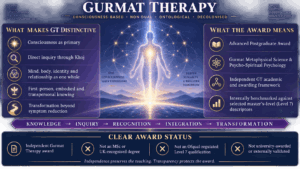
Gurmat Therapy is founded upon a non-reductionist ontology in which consciousness is not treated simply as a secondary product of cognition, behaviour or biology.
The programme examines the human being as an interconnected expression of consciousness involving mind, body, emotion, identity, relationship, meaning, health and lived experience.
It brings together:
- Gurmat wisdom and its consciousness-based ontology;
- psycho-spiritual and transpersonal psychology;
- contemplative and experiential inquiry;
- research and critical reflection;
- subjective and intersubjective experience;
- embodied awareness;
- ethical development;
- health, meaning and human flourishing; and
- the disciplined practice of Khoj—direct self-inquiry.
The programme asks participants not only to acquire knowledge but also to examine the consciousness, identity and assumptions through which knowledge is interpreted.
A Decolonised and Non-Reductionist Approach
Gurmat Therapy recognises that established academic systems have made substantial contributions to scholarship, research and professional education.
GT also recognises that no single educational or philosophical tradition has a complete monopoly upon knowledge, evidence or human understanding.
Some conventional frameworks have historically privileged externally observable, measurable and institutionally authorised forms of knowledge while giving less recognition to embodied, contemplative, indigenous, relational, subjective and consciousness-based ways of knowing.
GT’s independent educational approach creates space for forms of inquiry that may not fit comfortably within exclusively materialist or reductionist assumptions.
This does not involve rejecting evidence, intellectual discipline, critical examination or academic accountability. It involves widening the field of inquiry and asking whether the method used is appropriate to the reality being investigated.
A consciousness-based discipline must be capable of investigating lived consciousness, not merely theorising about it from the outside.
Why Gurmat Therapy Has Developed an Independent Award
Gurmat Therapy has chosen to develop its own distinctive programme and internal award because its ontology, methods of inquiry and understanding of transformation do not arise exclusively from conventional Western psychological or materialist academic frameworks.
The independent route enables GT to preserve:
- the integrity of Gurmat’s consciousness-based ontology;
- direct experiential inquiry as a legitimate field of investigation;
- Khoj as a disciplined method of self-examination;
- the integration of scholarship and lived experience;
- the relationship between knowledge, identity, conduct and transformation;
- culturally situated and decolonised ways of knowing; and
- the programme’s emphasis upon self-actualisation, self-realisation and self-sovereignty.
Independence does not mean exemption from transparency, evidence, ethical responsibility or rigorous assessment.
GT’s independence describes the origin and character of its programme. It does not constitute statutory accreditation, university validation, recognised degree status or Ofqual regulation.
The value of the programme should therefore be assessed according to its actual curriculum, teaching, experiential requirements, assessment, participant development, research and clearly stated awarding status.
What Makes the Programme Distinctive
The programme does not assess learning solely through the accumulation and reproduction of theoretical information.
Participants are expected to explore the relationship between:
knowledge → observation → inquiry → recognition → integration → transformation
Learning may involve examining:
- conditioned identity and the ego-complex;
- the relationship between consciousness and experience;
- patterns of thought, emotion and behaviour;
- the influence of worldview upon health and relationship;
- embodied and psycho-physiological experience;
- contemplative states and stages of consciousness;
- ethical responsibility;
- meaning, purpose and human potential;
- the transformation from reactive identity towards conscious living; and
- the practical expression of insight within everyday life.
The award recognises completion of a sustained educational and experiential process. It does not guarantee that every participant will experience the same personal, psychological, spiritual or health outcomes.
Learning Expectations
Participants are expected to demonstrate an increasingly developed capacity to:
- engage critically with relevant literature and ideas;
- distinguish assertion, interpretation, experience and evidence;
- examine assumptions underlying different psychological and ontological models;
- compare reductionist, transpersonal and consciousness-based frameworks;
- undertake disciplined self-observation and reflective inquiry;
- analyse subjective and experiential material systematically;
- integrate theory, experience and practice;
- communicate coherent and appropriately supported arguments;
- recognise ethical boundaries and limitations;
- respond constructively to assessment and supervision;
- undertake sustained independent inquiry; and
- complete a substantial dissertation or final research project.
Attendance alone does not result in the award.
Successful completion requires the participant to satisfy the programme’s published learning, assessment, experiential and research requirements.
Assessment
Assessment within the programme may include:
- written assignments;
- reflective and analytical submissions;
- critical engagement with literature;
- experiential inquiry records;
- structured self-observation;
- qualitative and subjective-data analysis;
- presentations and discussions;
- case-based learning;
- supervised developmental work;
- demonstration of ethical understanding;
- dissertation proposals;
- an extended dissertation or final research project; and
- evidence of integration across the programme.
Each participant’s work is assessed against the criteria specified by Gurmat Therapy for the relevant programme and cohort.
GT’s assessment decisions determine eligibility for the internal GT award. They do not constitute the conferral of academic credit or a recognised university qualification.
Dissertation and Independent Inquiry
The dissertation or final research project provides an opportunity for participants to investigate an appropriate subject in sustained depth.
Participants are expected to:
- identify a coherent area of inquiry;
- formulate an appropriate research question or focus;
- explain the conceptual and ontological foundations of the inquiry;
- engage with relevant literature and evidence;
- describe the method used;
- distinguish experience from interpretation;
- analyse material critically and reflexively;
- address limitations and ethical considerations; and
- communicate findings in a structured and coherent form.
GT dissertations are research outputs produced within Gurmat Therapy’s independent advanced programme.
They are not university master’s dissertations and must not be described as evidence that the author holds an MSc or other recognised degree.
 Internal Academic Governance and Quality Assurance
Gurmat Therapy is responsible for designing, delivering, assessing and internally awarding its programme.
Its academic framework is intended to support consistency, fairness and integrity through documented arrangements that may include:
- defined programme aims and learning outcomes;
- published completion requirements;
- assessment criteria and marking frameworks;
- dissertation guidance;
- assessor feedback;
- assessment records;
- internal moderation;
- supervision arrangements;
- academic-integrity expectations;
- procedures for reassessment;
- participant complaints and appeals;
- ethical safeguards;
- periodic curriculum review; and
- review of participant feedback and programme outcomes.
Only procedures that have been formally adopted and are operating for the relevant cohort should be represented as part of GT’s quality-assurance framework.
Internal quality assurance does not mean that the programme has been externally accredited, regulated or validated.
The Gurmat Therapy Award
A participant who successfully completes all applicable requirements may receive the:
Advanced Postgraduate Award in Gurmat Metaphysical Science & Psycho-Spiritual Psychology
The certificate will identify:
- the participant’s full name;
- the complete GT award title;
- Gurmat Therapy as the awarding organisation;
- the date of award;
- a unique award or certificate number; and
- the authorised GT signatories.
The certificate will state clearly that it is an independent Gurmat Therapy award and is not a UK-recognised degree or Ofqual-regulated qualification.
The certificate will not use “MSc,” “Master of Science,” “master’s degree,” “degree,” “accredited degree” or “Level 7 qualification” as the title of the award.
How Graduates May Describe the Award
Graduates may accurately state:
“I completed the Gurmat Therapy Advanced Postgraduate Programme and received the Advanced Postgraduate Award in Gurmat Metaphysical Science & Psycho-Spiritual Psychology.”
Graduates must not state or imply, on the basis of this award alone, that they:
- hold an MSc awarded by Gurmat Therapy;
- hold a recognised master’s degree;
- hold an Ofqual-regulated Level 7 qualification;
- attended or graduated from a university;
- received an award validated by a university;
- possess a licence or statutory registration to practise; or
- have received recognition from a professional body unless that body has expressly confirmed it.
GT may publish separate guidance explaining the correct way to present the award on a curriculum vitae, professional profile or website.
Professional and Practitioner Status
Completion of the programme does not, by itself, confer statutory registration, a legally protected healthcare title or automatic membership of an external professional body.
Where GT permits a graduate to use a proprietary GT practitioner designation, that designation confirms only that the graduate has satisfied the requirements established by Gurmat Therapy.
It must not be represented as registration or accreditation by Institution and bodies which are founded upon reductionist non-consciousness based frameworks, including the Health and Care Professions Council, the British Psychological Society, the UK Council for Psychotherapy, the British Association for Counselling and Psychotherapy, another healthcare regulator or any other professional organisation unless that organisation has expressly granted the relevant recognition.
Graduates remain personally responsible for:
- working within their competence;
- representing their qualifications accurately;
- maintaining appropriate insurance;
- observing safeguarding and data-protection responsibilities;
- obtaining any legally or professionally required registration;
- making appropriate referrals;
- avoiding unsupported health claims; and
- complying with the requirements applicable to their employment or professional practice.
Recognition by Employers, Universities and Other Organisations
GT cannot guarantee that its award will be accepted by:
- an employer;
- a university or college;
- a professional association;
- a statutory regulator;
- an immigration authority;
- a funding organisation;
- an insurer;
- an overseas recognition service; or
- another education or training provider.
Acceptance is determined independently by the receiving organisation according to its own requirements.
Anyone who needs the award for a particular employment, promotion, professional-registration, immigration, insurance or further-study purpose should obtain written confirmation from the relevant organisation before enrolling.
GT will provide accurate information about its curriculum and award status but cannot give an assurance on behalf of another organisation.
External Accreditation, Validation or Recognition
GT will only describe a programme or award as externally accredited, validated, regulated, approved, endorsed or recognised where:
- a formal arrangement exists;
- the relevant external organisation has authority to provide that recognition;
- the arrangement applies to the particular programme and cohort concerned; and
- GT is complying with the terms of that arrangement.
Any future recognition will be described precisely, including:
- the name of the external organisation;
- the nature of the recognition;
- the programme and cohort covered;
- the commencement and expiry dates, where applicable; and
- any limitations upon the recognition.
Recognition by one organisation must not be interpreted as recognition by any other organisation.
Historical Programme Terminology
GT is committed to ensuring that its current programme titles, website content, certificates, brochures and graduate information accurately distinguish its independent award from a recognised degree.
Any historical reference to “MSc,” “Master of Science,” “master’s dissertation” or similar degree terminology in connection with an internally awarded GT programme must not be understood as meaning that GT awarded a recognised UK MSc or held degree-awarding powers.
Current descriptions use:
- Advanced Postgraduate Programme for the programme;
- Advanced Programme Dissertation or Independent Research Dissertation for the final research work; and
- Advanced Postgraduate Award for the qualification awarded by GT.
GT is reviewing historical public-facing materials so that they do not create a continuing impression of recognised degree status.
Information Provided Before Enrolment
Before a participant enters into an enrolment agreement or makes a non-refundable financial commitment, GT will provide clear information concerning:
- the programme title;
- the precise title of the award;
- the independent and unregulated status of the award;
- programme content and duration;
- learning and experiential requirements;
- assessment and dissertation requirements;
- attendance and completion requirements;
- all compulsory fees and reasonably foreseeable additional costs;
- cancellation and refund provisions;
- complaints and appeals;
- professional and academic limitations;
- any significant health, psychological or experiential considerations;
- the use and protection of personal information; and
- any applicable terms and conditions.
Material qualification-status information will not be confined to this webpage or presented only after payment.
It will also appear prominently within relevant programme pages, application information, enrolment documentation and the pre-commencement declaration.
Our Commitment to Transparency
Gurmat Therapy makes the following commitments:
- We will describe our programme and award accurately.
- We will distinguish educational depth from formal regulatory recognition.
- We will not claim university status or degree-awarding powers.
- We will not describe an internal GT award as an MSc, degree or regulated Level 7 qualification.
- We will identify external accreditation or validation only where a formal and applicable arrangement exists.
- We will provide material qualification-status information before a participant commits to enrolment or payment.
- We will encourage participants to verify whether the award meets their individual professional or academic requirements.
- We will preserve the distinctive consciousness-based and decolonised character of the programme while maintaining clear public accountability.
Independent Verification
Prospective participants can obtain general information about recognised degrees and degree-awarding powers from:
- the UK Government guidance on recognised degrees;
- the Office for Students Register and degree-awarding-powers information; and
- the UK Government registers of regulated qualifications and recognised awarding organisations.
Participants should contact the relevant authority or receiving organisation directly where recognition is important to their decision.
Scope and Continuing Review
This page explains how Gurmat Therapy currently describes, assesses and internally awards its programme.
It does not constitute a legal determination that every historic or current reference to the programme appearing elsewhere complies with all applicable UK requirements.
That question requires consideration of the overall presentation across GT’s:
- website and navigation;
- programme pages;
- brochures and advertisements;
- search-engine titles and descriptions;
- application and enrolment documents;
- payment pages;
- participant communications;
- dissertation descriptions;
- certificates;
- graduate and practitioner profiles; and
- social-media material.
GT is committed to reviewing these materials collectively and correcting wording that could reasonably create the impression that it awards a recognised MSc, degree or regulated Level 7 qualification.
.Award Status: This is an independent Advanced postgraduate, professional and educational award issued by Gurmat Therapy. All references to “Master’s-level pathway” and “Level 7” refer solely to GT’s internal academic benchmarking of the programme’s learning and assessment expectations.
The GT award arises from a distinctive non-dual, consciousness-based and experiential framework that cannot be fully contained within conventional, standardised qualification models without altering its ontological foundations.
For this reason, GT preserves the award through its own independent academic and awarding framework. It is not presented as a UK-recognised MSc or degree, an Ofqual-regulated Level 7 qualification, or a university-validated award. Its exclusiveness lies in recognising forms of knowledge, embodiment and transformation that conventional frameworks are not presently structured to assess in their entirety.
Final Summary
The Gurmat Therapy programme is an independent, advanced, consciousness-based and ontological programme of education, experiential development and research.
Its intellectual and transformative ambitions are substantial.
Its formal status is equally clear:
It leads to an independent Gurmat Therapy Advanced Postgraduate Award. It does not lead to qualifications, degrees or MSc which are accredited or recognised by UK or other institutions or bodies which are based on reductionist and non consciousness based frameworks
Last reviewed: September 2025