
Gurmat as a Science of Consciousness
 Abstract
This paper examines the relationship between the Fibonacci sequence—an empirically observed mathematical pattern in natural systems—and the Mool Mantra, the foundational ontological articulation within Gurmat. While no direct mathematical or historical linkage exists, the analysis proposes that both point toward a deeper principle of ordered emergence. By distinguishing between pattern (Fibonacci) and ontology (Mool Mantra), the paper positions Gurmat as a science of consciousness—a systematic, experiential, and reproducible inquiry into the nature of reality. Drawing on qualitative research from over 40 master’s-level dissertations employing grounded theory, the paper demonstrates consistent patterns of psychological transformation and shifts in consciousness. The findings are situated within contemporary debates in complexity science and consciousness studies, contributing to the development of non-reductionist scientific paradigms.
Keywords
Gurmat, consciousness studies, Fibonacci sequence, ontology, grounded theory, qualitative research, self-organisation, non-duality, transpersonal psychology
1. Introduction
The question of whether reality is fundamentally ordered or emergent through stochastic processes remains central across scientific and philosophical inquiry. Mathematical structures such as the Fibonacci sequence have been widely observed in natural systems, suggesting patterned growth and optimisation (Livio, 2002; Ball, 2009). Concurrently, ontological traditions have articulated frameworks describing the nature of existence beyond observable phenomena.
The Mool Mantra, originating within the teachings of Guru Nanak, offers a concise articulation of reality as unified, self-existent, and dynamically creative. While traditionally interpreted within theological or philosophical contexts, it may also be approached as an ontological description of consciousness.
This paper explores whether:
Fibonacci describes the patterned unfolding of form, while the Mool Mantra describes the ontological ground from which such patterns emerge.
Furthermore, it advances the argument that Gurmat constitutes a science of consciousness, supported by systematic methodology and emerging qualitative evidence.
2. The Fibonacci Sequence and Patterned Emergence
The Fibonacci sequence is defined recursively, with each term derived from the sum of the preceding two values. As the sequence progresses, ratios between successive numbers converge toward the golden ratio (φ), a proportion frequently observed in natural systems (Livio, 2002).
Empirical research has identified Fibonacci-related structures in:
• Biological growth patterns (phyllotaxis)
• Spiral formations in shells and galaxies
• Branching systems in vascular and neural networks
From the perspective of complexity science, such patterns arise through:
• Self-organisation
• Constraint-based optimisation
• Iterative feedback processes (Kauffman, 1993; Mitchell, 2009)
Fibonacci therefore functions as:
A descriptive model of structured emergence within self-organising systems.
3. The Mool Mantra as Ontological Framework
The Mool Mantra articulates a non-dual ontology of reality characterised by unity, self-existence, and dynamic creativity. Its key principles include:
• Unity of existence (Ik Oangkaar)
• Self-revealing nature of reality (Sat Naam)
• Creative dynamism (Karta Purakh)
• Transcendence of temporality and duality
Within Gurmat, these are not abstract metaphysical propositions but experientially verifiable states, accessible through disciplined awareness and inquiry.
Accordingly, the Mool Mantra can be understood as:
An ontological description of consciousness as the ground of all phenomena.
4. Gurmat as a Science of Consciousness
4.1 Defining Science Beyond Reductionism
Conventional scientific paradigms emphasise third-person observation and quantification. However, domains such as consciousness inherently involve first-person experience, necessitating expanded methodological frameworks.
If science is defined as:
• Systematic inquiry
• Replicability
• Verifiability
then Gurmat satisfies these criteria within a first-person domain.
4.2 Methodological Structure
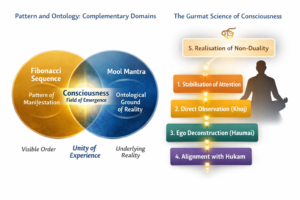
The Gurmat approach to inquiry involves:
1. Stabilisation of attention
2. Direct observation of internal processes (Khoj)
3. Deconstruction of egoic identity (Haumai)
4. Alignment with experiential order (Hukam)
5. Realisation of non-dual awareness
This constitutes a structured and replicable methodology for investigating consciousness.
4.3 Epistemological Position
Gurmat adopts a consciousness-primary ontology, wherein:
• Consciousness is fundamental
• Subject-object duality is provisional
• Experience is the primary domain of inquiry
This aligns with emerging perspectives in:
• Phenomenology
• Analytic idealism (Kastrup, 2019)
• Neurophenomenology (Varela et al., 1991)
5. Methodology and Empirical Evidence
5.1 Research Base
Over 40 master’s-level dissertations within Gurmat Therapy have employed grounded theory methodology to examine subjective transformation and shifts in consciousness.
These studies utilise:
• Longitudinal qualitative data collection
• Daily experiential mapping (qualia mapping)
• Thematic coding and constant comparison (Charmaz, 2006)
5.2 Key Findings
Across independent studies, consistent patterns have been observed:
1. Deconstruction of Egoic Identity
Participants report reduced identification with fixed self-concepts.
2. Reduction in Psychological Distress
Decreases in anxiety, rumination, and reactivity are consistently documented.
3. Emergence of Coherence
Increased alignment across cognitive, emotional, and physiological domains.
4. Ontological Shift
Transition from a separate self-model to an integrated, process-oriented awareness.
5. Transformation in Relationship to Death
Reduced fear of mortality and increased acceptance of impermanence.
5.3 Reproducibility
A notable feature is intersubjective consistency:
• Similar stages of transformation across participants
• Recurring experiential themes
• Convergence in descriptive language
This suggests that:
The transformations observed are structured and reproducible, rather than idiosyncratic.
6. Convergence with Contemporary Science
6.1 Complexity and Self-Organisation
Fibonacci reflects principles of self-organisation within complex systems (Kauffman, 1993). Gurmat describes a parallel principle—Hukam—as inherent order within reality.
6.2 Consciousness Studies
Near-death experience (NDE) research and related studies challenge reductionist models of consciousness (van Lommel et al., 2001; Greyson, 2003).
Theories such as Integrated Information Theory (Tononi, 2008) and analytic idealism (Kastrup, 2019) further suggest that consciousness may be fundamental.
Gurmat aligns with these perspectives, asserting:
Consciousness is primary, with form arising within it.
7. Pattern and Ontology: A Comparative Synthesis
The relationship between Fibonacci and the Mool Mantra can be summarised as follows:
Domain Description
Fibonacci Pattern of unfolding form
Mool Mantra Ontological ground of reality
This represents a complementary, not equivalent relationship.
8. Limitations
This paper does not claim:
• A mathematical encoding within the Mool Mantra
• Empirical proof of ontological assertions
• Interchangeability of scientific and experiential domains
Rather, it proposes a framework for interdisciplinary dialogue.
9. Conclusion
The Fibonacci sequence and the Mool Mantra offer distinct yet convergent insights into the nature of reality.
Fibonacci describes:
How structured patterns emerge within the observable universe
The Mool Mantra articulates:
The ontological nature of the field from which such patterns arise
Supported by a growing body of qualitative research demonstrating reproducible transformation, Gurmat may be positioned as:
A science of consciousness grounded in systematic inquiry, experiential verification, and intersubjective consistency.
Such a framework expands the scope of scientific investigation beyond reductionist limitations, offering a more comprehensive understanding of human experience and reality.
References
Ball, P. (2009). Shapes: Nature’s patterns. Oxford University Press.
Charmaz, K. (2006). Constructing grounded theory. Sage.
Dehaene, S. (2014). Consciousness and the brain. Viking.
Greyson, B. (2003). Near-death experiences. Psychiatric Services, 54(12), 1649–1651.
Kastrup, B. (2019). The idea of the world. Iff Books.
Kauffman, S. A. (1993). The origins of order. Oxford University Press.
Kelly, E. F., et al. (2007). Irreducible mind. Rowman & Littlefield.
Livio, M. (2002). The golden ratio. Broadway Books.
Mitchell, M. (2009). Complexity: A guided tour. Oxford University Press.
Singh, N. (2014). Sikhism: A comparative study. Motilal Banarsidass.
Singh, P. (2000). The Guru Granth Sahib. Oxford University Press.
Tononi, G. (2008). Consciousness as integrated information. Biological Bulletin, 215(3), 216–242.
van Lommel, P., et al. (2001). Near-death experience. The Lancet, 358, 2039–2045.
Varela, F. J., Thompson, E., & Rosch, E. (1991). The embodied mind. MIT Press.