 A Pioneering Decolonised and Ontological Approach to Consciousness, Healing and Transpersonal Health
Gurmat Therapy is a transformative, decolonised and consciousness-based framework for personal and transpersonal development. Its Advanced Postgraduate Pathway is designed for people working or interested in health, psychology, education, contemplative practice and spiritual care.
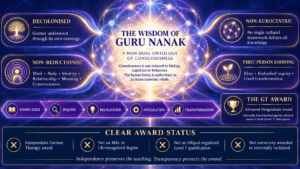
The programme returns first-person experiential knowing to the centre of psycho-spiritual inquiry. It draws deeply upon the ontological wisdom of Guru Nanak and the Gurmat tradition: a non-dual and non-reductionist understanding of consciousness, reality and selfhood.
Developed by Master Davinder Singh Panesar, Gurmat Therapy brings together decades of work in contemplative practice, consciousness studies, transpersonal psychology and Gurmat psycho-spiritual philosophy. It restores consciousness to the study of health, healing and human flourishing, offering an alternative to approaches that reduce human experience solely to biology, cognition, behaviour, diagnosis or pathology.
Decolonising the Self: Gurmat as Ontological Liberation
Gurmat Therapy returns to an experiential ontology that moves beyond belief, dogma and externally imposed definitions of the self.
Rooted in the insights of Guru Nanak, it approaches Gurmat as a path of direct inner inquiry into the nature of consciousness, identity and existence.
Rather than imposing an external hierarchy of truth, Gurmat invites the participant into lived and embodied inquiry. It is concerned not only with what a person believes, thinks or feels, but with the nature of the one having the experience.
From this perspective, realisation is not deferred to a distant future. It is cultivated through awareness, inquiry and transformation in the here and now.
At the heart of this approach is the non-dual recognition of the One within all beings and all beings within the One.
Bridging Science and Spirituality Through Consciousness
Gurmat Therapy offers an innovative integration of:
- ontological insight drawn from Guru Nanak’s non-dual experiential wisdom;
- contemplative and meditative practices refined through centuries of lived inquiry;
- mind-body science, consciousness studies and transpersonal psychology; and
- first-person, embodied and qualitative approaches to understanding human transformation.
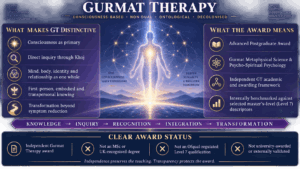
This integration recognises consciousness as primary to lived experience and healing as a multidimensional process involving physical, emotional, psychological, relational and transpersonal life.
Gurmat Therapy does not reject scientific inquiry or critical analysis. It expands the field of inquiry by recognising that consciousness cannot be understood fully through external observation alone.
A Consciousness-Based and Ontologically Grounded Curriculum
The Gurmat Therapy Advanced Postgraduate Pathway includes:
- immersive training in Gurmat-based contemplative practices, including Simran, Khoj, Dhyaan and Bhavana;
- daily meditative state-mapping and qualitative consciousness journalling;
- experiential exploration of mind, identity, Haumai and consciousness;
- residential retreats supporting sustained inner inquiry;
- integration of theory, lived experience and practical application;
- the development and delivery of a Gurmat-based contemplative intervention; and
- a final practice-based dissertation exploring transformation through consciousness.
Assessment is intended to honour both academic discipline and epistemic plurality. It may include written assignments, first-person inquiry, reflective and transformative learning portfolios, experiential mapping, qualitative analysis, supervised development and independent dissertation research.
The programme is not based upon attendance alone. Participants must satisfy the learning, experiential, assessment and research requirements established by Gurmat Therapy.
An Advanced Postgraduate Pathway
The programme is designed and internally benchmarked against selected academic expectations associated with master’s-level Level 7 study, including:
- critical engagement with complex ideas;
- independent inquiry;
- integration of theory and experience;
- research literacy;
- reflexive and qualitative analysis; and
- completion of a substantial dissertation or final research project.
“Master’s-level” and “Level 7” describe GT’s internal academic benchmarking of the programme’s intended learning and assessment demands.
They do not mean that the programme or resulting award is formally recognised or regulated at Level 7. The programme does not confer an MSc or other UK-recognised master’s degree.
Beyond Reductionism: Restoring Wholeness
Gurmat Therapy challenges frameworks that fragment the human being into separate biological, psychological, behavioural or diagnostic components.
Although these perspectives can contribute valuable knowledge, they may become limiting when their categories are treated as a complete description of human nature.
Gurmat Therapy affirms:
- ontological sovereignty: the capacity to inquire directly into the nature of self, experience and being;
- embodied liberation: understanding healing as recognition, integration and transformation rather than correction alone;
- transpersonal health: recognising that human wellbeing may include meaning, purpose, connectedness and consciousness;
- non-duality: investigating the apparent separation between self, consciousness and existence; and
- wholeness: approaching mind, body, identity, relationship and consciousness as interrelated dimensions of one lived reality.
The programme prepares participants to engage with processes of psycho-spiritual inquiry and transformation in service of awareness, wholeness, compassion and responsible practice.
It does not promise that every participant will experience the same personal, spiritual or health outcomes.
Independent Internal Validation and Awarding
Decolonial Integrity in Gurmat Therapy
Gurmat Therapy has developed an independent internal system for assessing and awarding learning undertaken within its own distinctive framework.
This internal approach supports the preservation of a decolonised and ontological curriculum that prioritises psycho-spiritual inquiry, embodied wisdom and lived transformation.
Many established academic and professional frameworks make valuable contributions through evidence, external scrutiny and standardisation. However, some frameworks are primarily designed around objective measurement, categorisation and third-person observation. They may not fully address the first-person, contemplative, non-dual and transpersonal dimensions that are central to Gurmat Therapy.
GT therefore maintains responsibility for the integrity of its own teachings, curriculum, experiential requirements and internal assessment.
This is more accurately described as independent internal academic validation and quality assurance, rather than external accreditation.
Preserving the Ontological Foundation
Gurmat Therapy is not simply a collection of therapeutic techniques. It is an integrated process of inquiry into consciousness, identity, relationship and being.
Its internal framework seeks to ensure that participants:
- understand the ontological foundations of Gurmat Therapy;
- engage with spiritual and contemplative practice as lived inquiry;
- develop the capacity for critical and reflexive examination;
- demonstrate integration rather than theoretical recall alone;
- recognise the ethical responsibilities associated with consciousness-based work;
- honour self-sovereignty in healing and transformation; and
- embody the principle of aap beechaarai so parvaan—the significance of examining and understanding oneself.
Internal validation helps GT protect its teachings from being separated from their philosophical, ethical and experiential foundations.
It does not mean that GT rejects external dialogue, critical scrutiny or appropriate forms of independent quality assurance.
A Decolonised Approach to Knowledge
A decolonised approach does not replace one unquestionable authority with another. It recognises that all systems of knowledge arise within particular cultural, philosophical and historical contexts.
Gurmat Therapy seeks to:
- understand Gurmat concepts through their own ontological foundations;
- protect non-Western knowledge from being reduced to Western psychological categories;
- recognise first-person and embodied experience as legitimate areas of disciplined inquiry;
- examine both Western and non-Western assumptions critically;
- integrate evidence without reducing consciousness to material processes alone; and
- maintain the relationship between knowledge, practice, ethics and transformation.
Independence enables GT to preserve this distinctive approach. It does not confer statutory accreditation, regulated qualification status or university recognition.
The Gurmat Metaphysical Science Academic Board
The Gurmat Metaphysical Science Academic Board supports the internal academic governance of Gurmat Therapy.
Its purpose is to help maintain the coherence and integrity of the programme through processes such as:
- curriculum development and review;
- defining learning and assessment expectations;
- reviewing experiential and contemplative requirements;
- supporting dissertation and research standards;
- maintaining ethical expectations;
- monitoring assessment and progression; and
- preserving the ontological foundations of Gurmat Therapy.
The Board is an internal GT academic body. It is not an Ofqual-recognised awarding organisation, statutory regulator, university or external accreditation agency.
The Gurmat Therapy Award
Participants who successfully complete the relevant requirements receive the:
Advanced Postgraduate Award in Gurmat Metaphysical Science and Psycho-Spiritual Psychology
The award is completed through the Gurmat Therapy Advanced Postgraduate Pathway and is issued by Gurmat Therapy through its internal academic and awarding framework.
The award recognises successful completion of GT’s advanced theoretical, experiential, research and professional-development requirements.
It is an independent Gurmat Therapy award.
Important Awarding Status
Gurmat Therapy:
- is not a university;
- does not hold UK degree-awarding powers;
- does not award an MSc or other UK-recognised degree;
- is not recognised by Ofqual as an awarding organisation;
- does not award an Ofqual-regulated Level 7 qualification; and
- does not currently offer this programme through validation by a recognised university or degree-awarding body.
References to master’s-level or Level 7 academic descriptors refer only to GT’s internal academic benchmarking. They do not mean that the programme is formally regulated or recognised at Level 7.
Completion of the programme does not automatically confer statutory professional registration, a legally protected healthcare title, recognised university credit or membership of an external professional body.
Prospective participants who require the award for employment, professional registration, insurance, immigration or further study should confirm its acceptability directly with the relevant organisation before enrolling.
For complete information about the academic framework, award, qualification status, graduate terminology and enrolment safeguards, please read:
Accreditation, Academic Standards and Awarding Status
In Summary
Gurmat Therapy is a pioneering, decolonised and consciousness-based approach to health, human development and psycho-spiritual transformation.
Grounded in the non-dual and ontological wisdom of Guru Nanak, it brings together contemplative practice, first-person inquiry, transpersonal psychology and consciousness studies.
Its independence protects the integrity of a framework that cannot be understood through reductionist or materialist categories alone. Its award remains clearly identified as an independent Gurmat Therapy professional and educational award, not an MSc, recognised degree or regulated Level 7 qualification.
Independence preserves the integrity of the teaching. Transparency protects the integrity of the award.