
Beyond The Kirpan, Beyond Behaviour:
The Missing Dimension of Violence Prevention in Education
Abstract
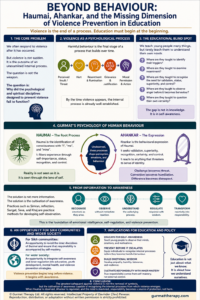
Public discussions surrounding violence frequently focus on behavioural outcomes, weapons, legislation, and enforcement. While these concerns are understandable, they often overlook the psychological processes that precede violent action. This article argues that violence is best understood not as an isolated behavioural event but as the culmination of an unexamined sequence of cognitive, emotional, and identity-based processes. Drawing upon the Gurmat concepts of Haumai and Ahankar, the paper proposes that many contemporary approaches to violence prevention focus primarily on external regulation while neglecting the cultivation of self-awareness, emotional literacy, and the capacity for inner observation. It further argues that Guru Nanak’s teachings contain a sophisticated psychology of human behaviour that may offer valuable insights for contemporary education, youth development, violence prevention, and emotional intelligence programmes. The article concludes by suggesting that the current challenges facing both religious and secular communities provide an opportunity to revisit education itself as a process of cultivating awareness rather than merely transmitting information.
Introduction
Incidents of violence inevitably generate public concern and often provoke discussion regarding the external factors associated with harmful behaviour. Questions are asked about weapons, social influences, community cultures, and legal frameworks. Such discussions are important. However, they frequently begin too late in the developmental sequence.
By the time violence becomes visible, the psychological processes that produced it have often been operating for weeks, months, or even years.
The act itself is observable.
The processes that generated the act are not.
This distinction is significant because it shifts attention from behaviour to the conditions that make behaviour possible. If violence is understood solely as a behavioural problem, interventions naturally focus upon controlling actions. If, however, violence is understood as the culmination of an internal psychological process, then prevention requires attention to the developmental mechanisms that precede behaviour.
This article proposes that contemporary educational systems, both religious and secular, devote insufficient attention to helping individuals recognise and regulate these mechanisms. While considerable effort is invested in teaching knowledge, values, and behavioural expectations, far less attention is given to the cultivation of self-awareness and the observation of the psychological processes through which harmful behaviour emerges.
Violence as a Developmental Psychological Process
One of the most persistent misconceptions regarding violence is the belief that it emerges suddenly. Although acts of aggression often appear impulsive, research across psychology, criminology, and behavioural science consistently suggests that harmful behaviour is usually preceded by identifiable emotional and cognitive developments.
Individuals rarely respond directly to objective events. Rather, they respond to their interpretation of those events. A perceived insult, exclusion, criticism, or challenge may be interpreted as disrespect, humiliation, rejection, or threat. Once such interpretations become emotionally charged, they initiate a sequence of reactions that progressively reinforce one another.
Hurt becomes resentment. Resentment becomes rumination. Rumination reinforces grievance. Grievance seeks justification. Justification creates moral permission.
The behavioural act represents the final stage of a process that has gradually acquired psychological momentum.
Importantly, individuals rarely experience this process as irrational. On the contrary, by the time aggressive behaviour emerges, the individual often experiences their response as entirely justified. The challenge therefore is not merely behavioural regulation but the development of awareness regarding the processes through which emotional reactions become convictions and convictions become actions.
This observation raises an important educational question: are individuals being taught to recognise these processes while they are occurring?
The Educational Blind Spot
Contemporary education excels at transmitting information. Young people learn history, mathematics, science, language, and vocational skills. Religious education similarly teaches doctrine, scripture, ritual, ethics, and communal identity.
Yet a fundamental question remains largely unaddressed.
Where are individuals systematically taught to recognise resentment as it first emerges?
Where are they taught to examine insecurity?
Where are they taught to identify the need for validation, superiority, recognition, or control?
Where are they taught to observe emotional triggers before those triggers become behaviour?
Where are they taught to distinguish between reality and their interpretation of reality?
The absence of such education creates a significant developmental gap. Individuals may possess knowledge, skills, and even strong moral convictions while remaining largely unaware of the psychological processes shaping their behaviour. Consequently, emotional reactions often remain unconscious until they have already acquired behavioural expression.
The challenge is therefore not merely informational.
It is observational.
The issue is not whether individuals know what is right.
The issue is whether they can recognise what is occurring within themselves before they act.
Haumai and the Construction of Reactive Identity
It is here that Guru Nanak’s teachings offer a potentially important contribution.
At the centre of Gurmat psychology lies the concept of Haumai. While often translated as ego, Haumai refers more precisely to the process through which consciousness becomes organised around a self-referential identity. Experience becomes filtered through the continual activity of “I”, “me”, and “mine”. Events are evaluated according to their implications for personal importance, status, recognition, security, and self-image.
From this perspective, psychological suffering and interpersonal conflict arise not merely from external events but from the meanings attached to those events through the lens of self-centred identification.
The significance of this insight is profound. A challenge to an opinion may be experienced as a challenge to identity. A disagreement may become disrespect. Criticism may become humiliation. The emotional intensity of the reaction often reflects not the event itself but the degree to which identity has become attached to a particular interpretation of reality.
Haumai therefore provides a framework for understanding why seemingly minor incidents can generate disproportionately intense reactions. The individual is not simply defending an idea or responding to a situation. They are defending a psychological construction of self.
Ahankar and the Escalation of Conflict
If Haumai describes the structure of egoic identification, Ahankar describes its active expression.
Ahankar seeks validation, certainty, superiority, recognition, and significance. It resists correction and struggles with ambiguity. It experiences challenge as threat and disagreement as opposition.
When left unexamined, Ahankar gradually transforms emotional reactions into behavioural tendencies. The desire to be right becomes rigidity. The desire to be respected becomes domination. The desire to belong becomes tribalism. The desire to protect identity becomes hostility toward anything perceived as threatening that identity.
Violence, from this perspective, is not an isolated act but one possible outcome of a process in which emotional reactions have become fused with egoic structures.
The crucial point is that these processes are often invisible to the individual experiencing them.
The problem is not that Haumai and Ahankar exist.
The problem is that they remain unobserved.
From Information to Awareness
The educational implications of this analysis are significant.
If harmful behaviour emerges from unexamined psychological processes, then prevention requires more than moral instruction and behavioural management. It requires the cultivation of awareness itself.
This is where Gurmat moves beyond diagnosis and offers practical intervention.
Practices such as Simran, contemplative reflection, Sangat, Seva, and Khoj may be understood as methods for strengthening self-observation. Their function is not merely devotional. They cultivate the capacity to recognise internal states before those states become behaviour.
The individual learns to recognise resentment while it is still resentment.
To recognise pride while it is still pride. To recognise insecurity while it is still insecurity. To recognise the need for validation before it begins directing behaviour. In contemporary psychological language, these practices develop emotional intelligence, metacognitive awareness, emotional regulation, and self-reflective capacity.
The significance of this shift cannot be overstated. Prevention occurs not at the point of behaviour but at the point of awareness.
The earlier the process is recognised, the greater the possibility of transformation.
An Opportunity for Sikh Communities and Wider Society
The relevance of these insights extends far beyond any single community.
Across contemporary society, increasing attention is being given to mental health, emotional intelligence, violence prevention, youth development, and social cohesion. Yet many interventions remain focused upon symptoms rather than causes. The cultivation of self-awareness remains underdeveloped within both educational and community settings.
This presents an opportunity.
For Sikh communities, it is an opportunity to revisit the psychological dimensions of Gurmat and to consider whether sufficient attention is being given to the practical study of Haumai and Ahankar alongside history, identity, and external practice.
For educators, psychologists, youth workers, and policymakers, it is an opportunity to explore whether the development of self-observation and emotional literacy should occupy a more central position within educational frameworks.
For wider society, it is an opportunity to recognise that violence prevention begins long before violence itself.
It begins with awareness.
Conclusion
The challenge of violence cannot be reduced to behaviour alone. Harmful actions emerge from internal processes that often remain unnoticed until they have already acquired behavioural expression. Effective prevention therefore requires attention not only to what individuals do, but to how they interpret, experience, and regulate their inner worlds.
Guru Nanak’s analysis of Haumai and Ahankar offers a sophisticated framework for understanding these dynamics. More importantly, it offers practical methods through which awareness can be cultivated and reactive patterns recognised before they become action.
The question facing contemporary education is therefore not simply what individuals should know.
The deeper question is whether they are being taught how to observe themselves.
Until self-awareness becomes a central educational objective, society will continue responding to violence after it has occurred rather than addressing the conditions from which it emerges.
© Gurmat Therapy Ltd. All rights reserved. Intellectual Property of Davinder (Dav) Panesar. Reproduction, distribution, or adaptation without written permission is strictly prohibited. Visit gurmattherapy.com | the-flame.co.uk.