
Beyond Conversion: Spiritual Longing, Identity Fusion, and the Vulnerability of Awakening to Ideological Capture
Abstract
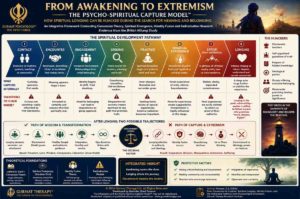
Research on religious conversion, spiritual transformation, and radicalisation has largely developed within separate academic traditions. Conversion studies have focused on the processes through which individuals adopt new religious identities, while radicalisation research has examined pathways leading to ideological extremism and intensified group commitment. Despite substantial overlap in the psychological mechanisms involved, little attention has been given to the possibility that the developmental processes associated with authentic spiritual awakening may simultaneously create vulnerabilities to ideological capture.
Drawing upon Lofland and Stark’s (1965) conversion theory, Stanislav Grof’s concept of Spiritual Emergency, Identity Fusion Theory, contemporary radicalisation models, and qualitative data from a grounded theory study of British Nihangs, this article proposes an integrative framework linking spiritual transformation and ideological vulnerability. The findings suggest that transformative spiritual experiences often generate a prolonged period of existential longing, identity reconstruction, and intensified meaning-seeking. While this process may facilitate profound personal development, it may also increase susceptibility to charismatic authorities, absolutist interpretations, and highly cohesive ideological groups.
The article argues that the critical vulnerability point is not conversion itself but the period immediately following awakening experiences. This phase, characterised by longing for deeper understanding and renewed contact with transcendent states, creates conditions in which authentic spiritual impulses may become redirected towards increasingly rigid forms of identity and belonging. The paper introduces the concept of Psycho-Spiritual Capture to describe this process and proposes a developmental model linking conversion, spiritual emergence, identity fusion, and radicalisation.
Introduction
The search for meaning, belonging, and identity has long occupied a central place within the psychology of religion. Classical conversion studies sought to understand how individuals adopt new religious identities and commit themselves to systems of belief and practice. More recently, research into radicalisation has examined how individuals become increasingly committed to ideological movements, including those characterised by extremism and militancy. Although these literatures have evolved largely independently, both are concerned with fundamental questions of identity transformation, commitment, and meaning-making.
The present article argues that an important developmental process remains under-theorised within both fields. Specifically, the psychological consequences of transformative spiritual experiences have received insufficient attention as potential mechanisms influencing subsequent identity development. While conversion research has traditionally focused upon the adoption of religious identity, and radicalisation studies upon the adoption of ideological identity, neither field has adequately examined the liminal period that often follows profound spiritual awakening.
This omission is significant because awakening experiences frequently destabilise existing assumptions about self, reality, and meaning. Such experiences may generate intense existential questioning, emotional openness, and a powerful desire to understand and integrate what has occurred. These processes create opportunities for growth, but they may also create vulnerabilities.
The central thesis of this article is that spiritual awakening constitutes a developmental opening rather than a developmental endpoint. What follows awakening may determine whether the individual moves towards greater psychological maturity, spiritual depth, and integration, or towards increasingly rigid forms of identity, ideological certainty, and group attachment.
Conversion Theory and the Missing Stage
The work of Lofland and Stark (1965) remains one of the most influential models within conversion research. Their framework proposed that conversion emerges through a sequence involving enduring tension, a religious problem-solving perspective, active seeking, encounter with a religious movement, the formation of affective bonds, and progressive commitment.
Subsequent research has supported many aspects of this model, particularly the emphasis placed upon meaning-seeking and social attachment. However, the model was primarily concerned with explaining entry into religious groups rather than examining long-term developmental trajectories following conversion.
The grounded theory study of British Nihangs largely confirmed elements of the Lofland and Stark framework. Participants described pathways involving contact with Sikh traditions, encounters with Nihang communities, progressive engagement, active seeking, and increasing commitment. These processes were accompanied by intensive spiritual practices, particularly Naam Simran, which participants associated with significant changes in identity, perception, and worldview.
However, the findings also suggested the presence of an additional stage not adequately addressed within existing conversion theory. Following transformative experiences, participants consistently described an enduring sense of longing. This longing was not simply a desire to maintain group membership or affirm beliefs. Rather, it reflected an attempt to reconnect with, understand, and deepen experiences perceived as profoundly meaningful and transformative.
This observation suggests that conversion may not represent the culmination of the developmental process. Instead, conversion may function as a threshold beyond which a new phase of seeking emerges.
Spiritual Awakening and the Emergence of Longing 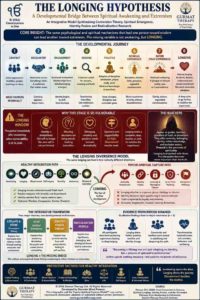
Transpersonal psychology provides important insights into this process. Stanislav Grof’s work on Spiritual Emergency challenged conventional assumptions that unusual spiritual experiences necessarily reflect psychopathology. Instead, Grof argued that transformative experiences frequently initiate processes of psychological reorganisation and identity reconstruction.
From this perspective, awakening experiences may be understood as disruptions to previously stable meaning systems. Individuals often report experiences of non-duality, interconnectedness, ego-transcendence, or altered states of consciousness that cannot easily be assimilated into existing frameworks of understanding.
The consequences of such experiences are profound. Previous identities may no longer appear sufficient. Established assumptions regarding self and reality may become destabilised. Ordinary life can appear diminished in comparison to what has been experienced.
The result is often longing.
Longing emerges because the individual has encountered a possibility that exceeds previous experience. A discrepancy develops between ordinary consciousness and the remembered experience of expanded awareness. The individual therefore seeks explanations, practices, teachers, and communities capable of helping them understand, reproduce, or stabilise these states.
Within the British Nihang data, this process was evident in participants’ descriptions of increasingly intensive engagement with spiritual practices and communities following significant experiences of transformation. What began as curiosity frequently evolved into a sustained search for deeper understanding and greater proximity to what had been glimpsed.
Identity Reconstruction and Fusion
The period following awakening may be characterised as one of identity reconstruction. Existing identities have been disrupted, yet new identities remain under development. During this period individuals become particularly receptive to communities that appear capable of providing meaning, coherence, and belonging.
Identity Fusion Theory offers a useful framework for understanding this process. Unlike traditional social identity theories, which emphasise group membership, identity fusion describes a state in which personal and collective identities become deeply integrated. The individual experiences the group not as an external affiliation but as an extension of the self.
For individuals emerging from transformative experiences, highly cohesive spiritual communities may provide an attractive environment for identity reconstruction. Shared narratives, rituals, symbols, and collective purpose offer a means of integrating otherwise difficult experiences.
However, the same processes that facilitate integration may also facilitate dependency. The individual’s longing for understanding becomes increasingly linked to group membership. Commitment to the group becomes associated with commitment to the experience itself. Over time, spiritual aspiration may become inseparable from collective identity.
At this point, the object of devotion begins to shift. The original experience of transcendence becomes mediated through specific authorities, interpretations, and social structures.
Radicalisation as Captured Meaning
Contemporary radicalisation models consistently emphasise the importance of cognitive openings, significance quests, identity uncertainty, and belonging needs. These concepts bear striking similarities to the processes described within both conversion research and spiritual emergence literature.
The significance quest model, for example, proposes that individuals become increasingly susceptible to ideological narratives when searching for meaning, purpose, and personal significance. Awakening experiences may inadvertently intensify precisely these motivations.
The individual has encountered something experienced as profoundly meaningful. They seek explanations capable of accounting for it. They seek communities that validate it. They seek authorities who appear to understand it.
Under favourable conditions, these processes support growth and maturation. Under less favourable conditions, they may facilitate ideological closure.
The present article proposes the concept of Psycho-Spiritual Capture to describe this process. Psycho-Spiritual Capture occurs when the longing generated by authentic spiritual experience becomes progressively redirected towards external authorities, ideological systems, or exclusive group identities. The individual continues to pursue meaning, but the search narrows. Exploration gives way to certainty. Inquiry gives way to defence. Spiritual development becomes increasingly subordinated to identity maintenance.
The transition is often subtle. The individual’s commitment appears spiritual, yet the underlying orientation gradually shifts from the pursuit of truth towards the preservation of a particular interpretation of truth.
An Integrative Developmental Model
The evidence reviewed suggests a developmental sequence extending beyond traditional conversion frameworks:
Contact → Encounter → Engagement → Seeking → Practice → Transformative Experience → Longing → Identity Reconstruction → Identity Fusion → Ideological Consolidation
At each stage opportunities for development coexist with opportunities for capture.
The same longing that motivates spiritual growth may motivate ideological commitment.
The same search for meaning that facilitates awakening may facilitate radicalisation.
The same desire for belonging that supports community formation may support exclusivist identities.
The determining factor is not the existence of longing itself, but the manner in which that longing becomes interpreted, organised, and embodied.
Conclusion
Conversion theory, spiritual emergence research, identity fusion theory, and radicalisation studies have each identified important dimensions of human transformation. Yet these fields have rarely been integrated into a unified developmental framework.
This article proposes that the period following spiritual awakening represents a critical but under-recognised stage within identity development. The British Nihang data suggests that transformative experiences frequently generate profound longing, intensified seeking, and ongoing identity reconstruction.
While these processes may lead towards greater wisdom, integration, and spiritual maturity, they may also create vulnerabilities to ideological capture. Understanding this vulnerable window is therefore essential not only for conversion research but also for broader discussions concerning spirituality, extremism, identity, and human development.
Future research should examine whether similar patterns emerge across other religious, spiritual, and ideological traditions. Such work may contribute to a more comprehensive understanding of how authentic experiences of transcendence become integrated into identity and why, under certain conditions, the search for truth may become transformed into the defence of certainty.
(c) All Rights Reserved 2026 D S panesar